

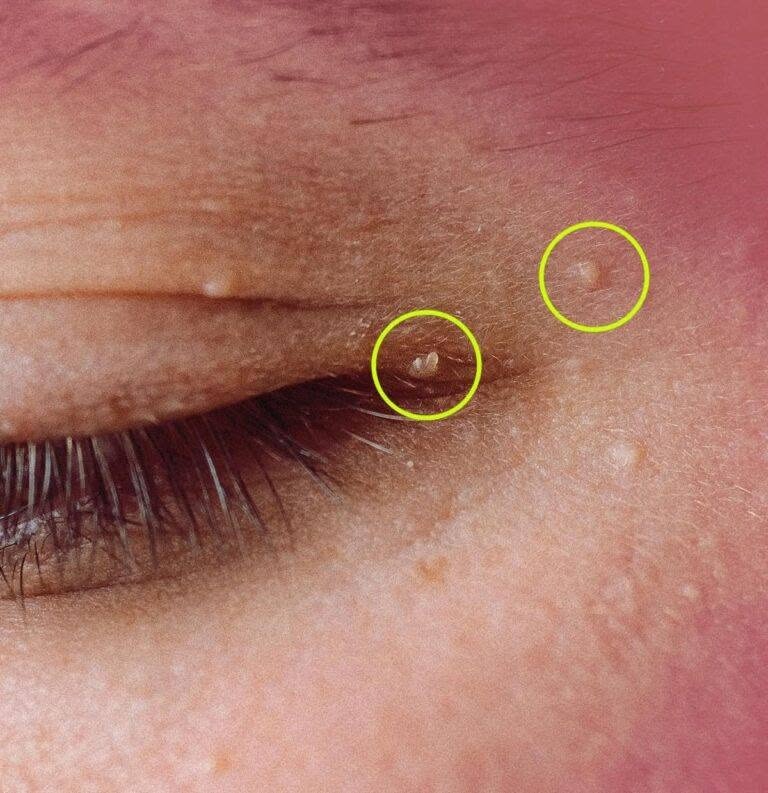
Topical retinoids are among the treatments that may be considered for some people with milia.
Cleveland Clinic lists over-the-counter adapalene and prescription tretinoin among potential treatment approaches, while DermNet notes that topical retinoids may be useful for widespread milia.
But retinoids can cause irritation and aren’t appropriate for everyone or every area of the face.
Don’t casually apply a strong retinoid directly next to your eyes.
If your milia are concentrated around the eyelids or you’re unsure what product is appropriate, ask a dermatologist.
Pregnant people or those trying to become pregnant should also seek medical advice before considering topical retinoid therapy.
Don’t Forget Sunscreen
Sun protection is another sensible part of a healthy skin-care routine.
Use a broad-spectrum sunscreen appropriate for your skin and follow the product directions.
This won’t necessarily make an existing milium disappear overnight, but protecting your skin from excessive UV exposure has benefits far beyond milia.
Cleveland Clinic includes sunscreen among its home-care recommendations for people with milia.
Professional Extraction
If you want an established milium removed quickly, professional extraction is one option.
A healthcare professional can carefully create a tiny opening and remove the trapped keratin.
DermNet describes de-roofing the lesion with a sterile needle or blade followed by removal of its contents as one treatment method.
This is very different from standing in front of your bathroom mirror and squeezing the bump.
Professional technique reduces unnecessary trauma and is particularly valuable when milia are located in delicate areas.
Other Treatments a Dermatologist May Consider
Not every case is treated the same way.
Depending on the number, location, and type of milia, professional options can include extraction and, in selected situations, treatments such as cryotherapy, curettage, topical retinoids, chemical peels, dermabrasion, or laser procedures.
That doesn’t mean someone with two tiny white bumps needs an aggressive procedure.
Most people don’t.
Treatment should match the individual situation.
What If the Bumps Keep Coming Back?
Recurring bumps are a good reason to have the diagnosis confirmed.
Something that looks like milia to you may occasionally be another type of skin lesion.
A dermatologist can distinguish milia from conditions that may look similar and recommend an appropriate treatment plan.
This is particularly useful if you’ve been treating the bumps for months without improvement.
Milia Around the Eyes Require Extra Care
Continued on next page:
To see the full cooking instructions, go to the next page or click the Open button (>) and don't forget to SHARE it with your friends on Facebook.