

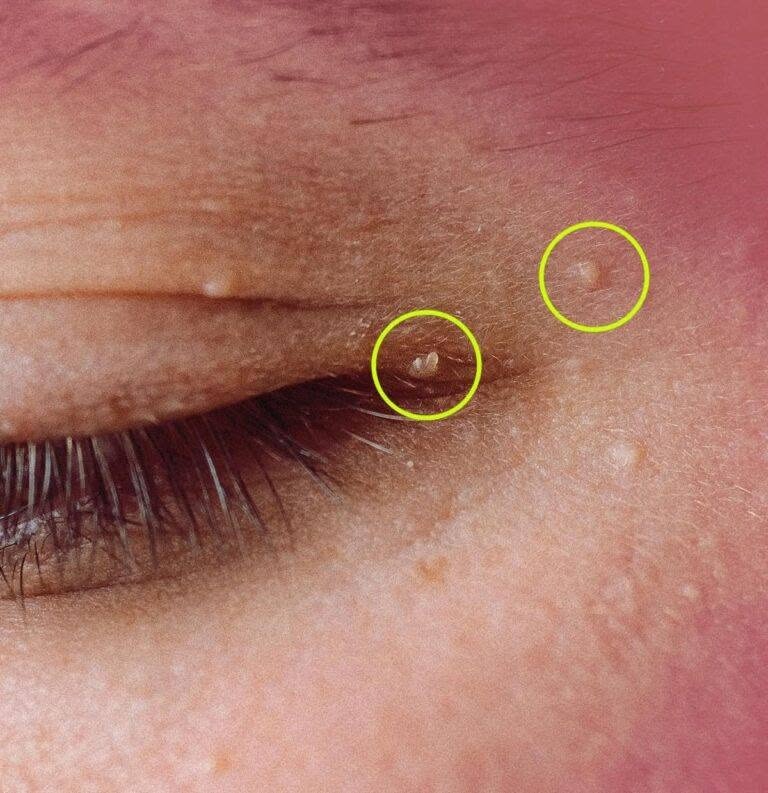
The eye area deserves special attention because the skin is thin and sensitive.
Avoid putting harsh acids, homemade lemon mixtures, rough scrubs, or sharp objects close to your eyes.
If you have persistent bumps directly on or very close to your eyelids, professional evaluation is safer than attempting DIY extraction.
A tiny cosmetic bump isn’t worth risking an eye injury.
What About Milia in Babies?
Milia are extremely common in newborns.
DermNet and Cleveland Clinic report that roughly 40% to 50% of newborns develop them.
These tiny bumps generally don’t need treatment.
Don’t squeeze them.
Don’t scrub them.
And don’t start applying adult acne products, exfoliating acids, or retinoids to a baby’s skin.
Cleveland Clinic notes that neonatal milia typically resolve without treatment.
If you’re uncertain about any rash or skin lesion on a baby, ask the child’s healthcare professional.
Can Milia Be Prevented Completely?
Not necessarily.
Some people simply seem more prone to developing them.
Good skin care can help maintain the skin barrier and normal turnover, but there isn’t a guaranteed routine that prevents every milium.
You can nevertheless avoid unnecessary skin trauma, use products appropriate for your skin, protect yourself from excessive sun exposure, and avoid aggressive DIY extraction.
A Simple Routine for Milia-Prone Skin
Your routine doesn’t need fifteen products.
In the morning, gently cleanse your skin if needed, apply an appropriate moisturizer, and use broad-spectrum sunscreen.
At night, remove makeup and sunscreen thoroughly and cleanse gently.
If an exfoliating product or retinoid is appropriate for you, use it according to professional or product guidance rather than combining multiple strong ingredients at once.
Consistency is generally more sensible than aggressive treatment.
When Should You See a Dermatologist?
Continued on next page:
To see the full cooking instructions, go to the next page or click the Open button (>) and don't forget to SHARE it with your friends on Facebook.