

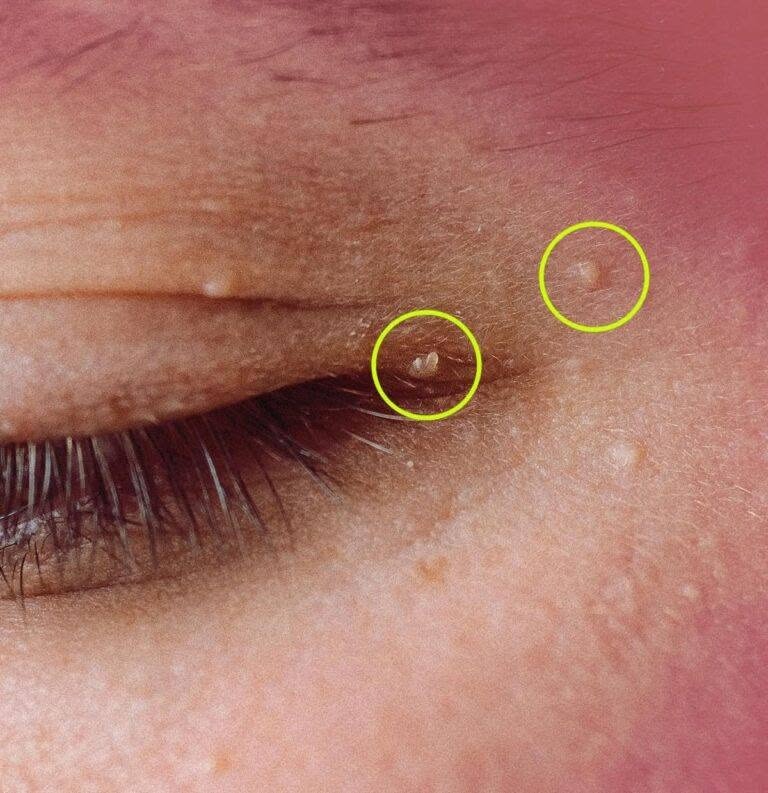
Harsh physical exfoliation isn’t the answer either.
Large sugar particles rubbed vigorously across facial skin can cause irritation.
If you’re already dealing with sensitive skin or bumps around your eyes, aggressive scrubbing may create an additional problem without removing the milia.
Gentle skin care is usually a better strategy than trying to mechanically scrub the cyst away.
Does Honey Remove Milia?
Honey has characteristics that have led to its use in many traditional skin-care preparations, but that doesn’t establish it as a reliable treatment for removing established milia.
If you enjoy a properly formulated honey-containing cosmetic product and your skin tolerates it, that’s one thing.
But you shouldn’t expect honey to dissolve a keratin cyst beneath the skin.
The same principle applies to many viral DIY remedies.
“Natural” doesn’t automatically mean effective, and it doesn’t automatically mean irritation-free.
What About Pomegranate Peel?
Ground pomegranate peel mixed with honey is another remedy sometimes promoted online.
However, it isn’t an established first-line dermatological treatment for milia.
There is no need to repeatedly apply abrasive homemade mixtures to your face in an attempt to remove these bumps.
If milia aren’t bothering you, leaving them alone is safer.
If they are bothering you, evidence-based skin care or professional treatment makes more sense.
A Better At-Home Approach
For most people, an at-home routine should focus on keeping the skin healthy rather than trying to physically remove each milium.
Start with a gentle cleanser.
Wash your face without aggressive scrubbing and gently pat the skin dry.
Cleveland Clinic recommends routine gentle cleansing and sun protection as reasonable home-care measures.
Keep the routine simple and consistent.
Gentle Exfoliation May Help Some Adults
Adults may consider appropriate exfoliating products to support normal skin-cell turnover.
But “more exfoliation” doesn’t mean “better.”
Over-exfoliating can damage the skin barrier, causing redness, burning, dryness, and irritation.
If you use an exfoliating product, follow its directions and introduce it gradually.
Be particularly careful with products used near the eyes.
What About Retinoids?
Continued on next page:
To see the full cooking instructions, go to the next page or click the Open button (>) and don't forget to SHARE it with your friends on Facebook.