
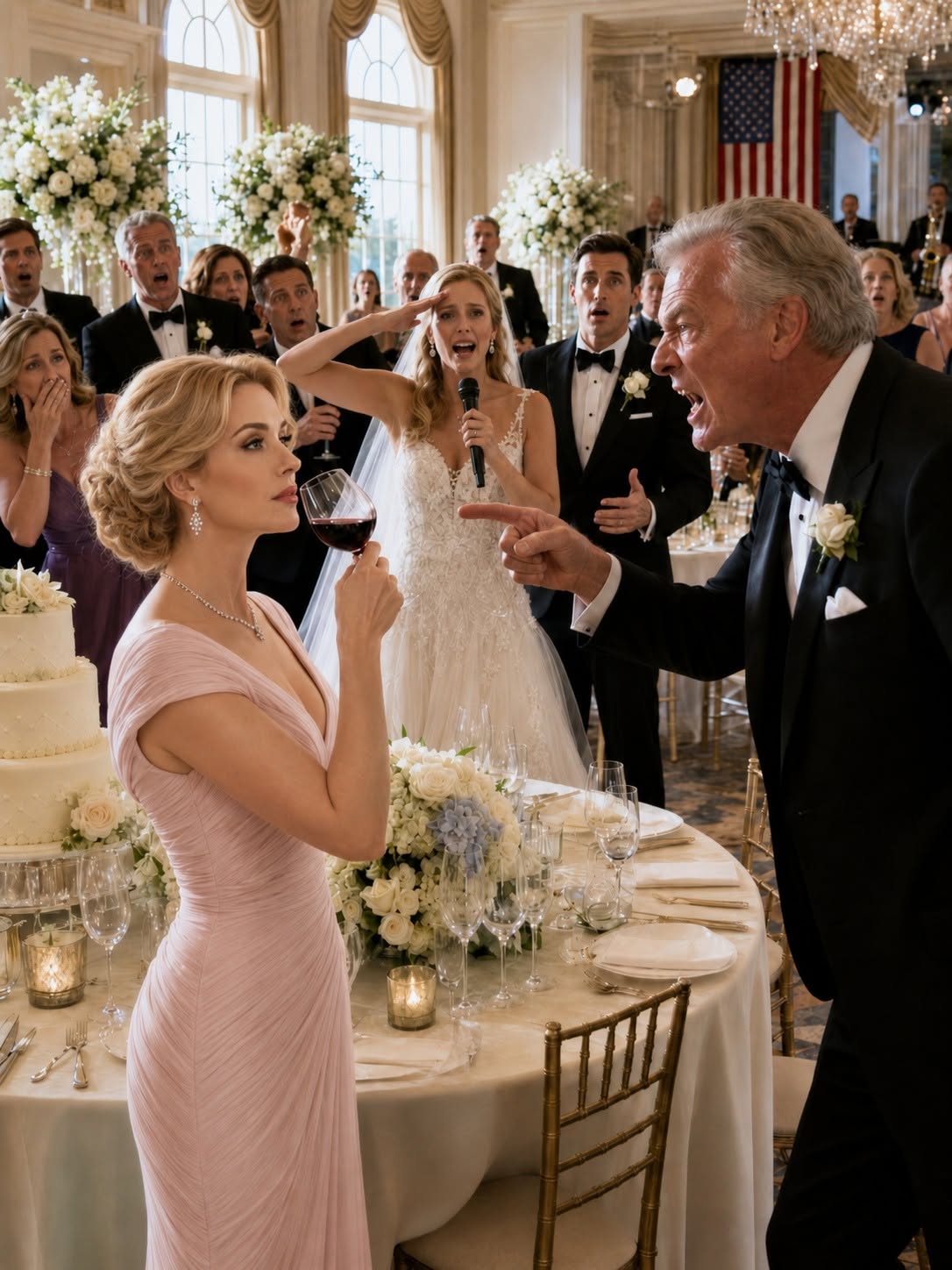
Griffin laughed first—because he had always needed permission from himself before being cruel.
“Still dramatic,” he said. “I told Calder this was a mistake. Weddings are supposed to be about happiness.”
A man in a gray tuxedo beside him chuckled into his napkin. A woman in pearls glanced between my dress and my empty ring finger, as though worth could be measured in fabric and jewelry.
I set my wineglass down carefully.
“Calder invited me,” I said. “So I came.”
My father made a faint, dismissive sound. “Calder is young. Sentiment makes young men careless.”
“He’s thirty,” I replied.
“He’s still young enough to believe blood excuses absence,” he said.
That line landed closer than I wanted it to—not because it was fair, but because Calder had once asked me something similar in a letter I had never forgotten.
He had found me through an old post office box I kept for formal correspondence I never sent home. His first letter was handwritten—thick paper, careful ink, no corporate polish.
“Aunt Maren,” it began, “I don’t know what happened between you and my father, but nobody will tell me the truth.”
I had read that sentence twice.
He wrote that he remembered me from one afternoon when he was six—when I took him to the park because his mother had a migraine and the men were in a meeting. He remembered the swing. The blue popsicle. My voice telling him, never confuse loud people with strong ones.
He remembered it. I had not.
His letter ended simply: he was getting married in July, and he wanted at least one person there who understood that the Rowe name and the Rowe truth were not the same thing.
That was why I came.
Not for my father. Not for Griffin. Not for forgiveness. And not to reclaim anything that had already been taken.
I came because one child had held onto one sentence for twenty-four years.
My father did not know that. He only saw an opening.
“So tell us,” Alden said, lifting his glass slightly, “what do you do now? Office work? Nonprofit? Teaching? I heard something vague years ago—government, perhaps. Low level, I assume.”
Griffin leaned toward the table. “She always liked pretending rules made her important.”
I could have answered.
I could have named places that would have changed the way every person in that room looked at me. I could have listed offices, operations, briefings, waters they would never see, decisions made in silence where no applause existed.
Instead, I said, “I keep busy.”
Griffin laughed. “That’s what unemployed people say.”
“No,” I replied calmly. “It’s what busy people say.”
His smile tightened.
My father studied me more carefully now. I could feel it—the shift. The irritation of a man who couldn’t file me into a category that made him comfortable.
He had expected broken. Small. Grateful.
Not this quiet steadiness.
Alden leaned in again. “Don’t confuse Calder’s invitation with reconciliation. You chose to leave this family.”
“You threw my bags into the rain.”
“You refused your responsibility.”
“You tried to sell my life,” I said evenly.
A few guests shifted uncomfortably.
Griffin’s voice dropped. “Careful.”
“I am,” I said.
My father’s jaw tightened, as though swallowing something sharp. Then his eyes dropped to my wrist.
The bracelet had slipped out from my sleeve.
Thin. Simple. Engraved with coordinates that meant nothing to anyone in that room.
Except him.
His gaze lingered.
“What is that?” he asked.
“A reminder,” I said.
“Of what?”
“That storms end.”
For the first time, he had no immediate reply.
A burst of laughter came from the head table, breaking the tension. Calder was speaking to his bride, Liora Vance, and attention drifted away from us.
Liora was striking—not in the way the room was designed to define beauty, but in the way she held stillness. She didn’t perform softness or status. She simply existed with quiet control, like someone used to pressure that didn’t come from chandeliers.
And I recognized it.
Not from weddings.
From something else.
Brighter rooms. Sterile lights. Early mornings. Briefings. A young officer standing alone while people tried to bury her voice under authority she refused to accept.
My hand tightened slightly around my glass.
Liora suddenly turned her head.
Her eyes met mine.
At first, nothing.
Then everything changed.
The color drained from her face.
Her posture straightened instantly. Her hand, resting near Calder’s, stiffened against the tablecloth.
Calder leaned in. “Liora?”
She didn’t answer.
She was staring at me like she had seen something she was never supposed to see again.
My father followed her gaze, then frowned. “What is wrong with her?”
Griffin muttered, “What’s going on with the bride?”
I didn’t respond.
Across the room, Liora slowly stood.
The string quartet faltered mid-note.
And for the first time that night, I felt something long buried begin to surface—something my family had never been prepared to face.

Part 3
SEE NEXT PAGE >>>
To see the full cooking instructions, go to the next page or click the Open button (>) and don't forget to SHARE it with your friends on Facebook.