

Trying to Understand What I Was Looking At
Once the initial shock passed, I forced myself to get a little closer. Carefully. Hesitantly.
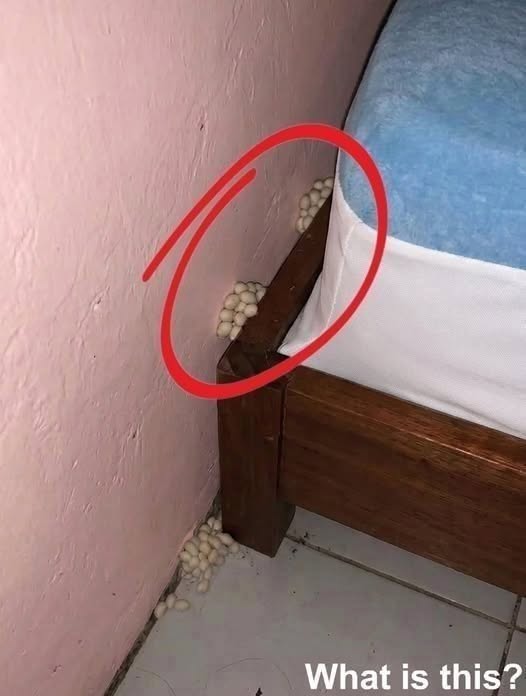
The clusters were small, round, and pale white. They weren’t moving. They didn’t seem alive in that moment, but they clearly had a biological appearance—something organic rather than artificial.
They were grouped tightly together, almost like they had been placed there intentionally. That detail made it even more unsettling.
I started trying to analyze the situation logically:
Why would something gather in corners like that?
Why near the bed specifically?
Why multiple clusters instead of just one?
And most importantly… what exactly were they?
But the more I looked, the less certain I became.
The internet was the obvious next step in my mind, but I hesitated. I wasn’t sure I wanted to confirm what I was afraid it might be.
Still, curiosity won over fear.
The Moment of Realization
After searching and comparing images, I slowly started to understand what I might be dealing with.
What I had found was most likely related to an insect infestation—tiny egg clusters hidden in tight, dark spaces close to where humans sleep.
And suddenly, everything about the situation started to make more sense in the worst possible way.
The location. The shape. The clustering pattern. The preference for corners and wooden frames.
It all pointed to one uncomfortable conclusion: something had been living—or reproducing—very close to where I sleep.
That realization changed everything.
What had started as a strange visual discovery became a potential warning sign of a larger issue hiding in plain sight.
Why These Clusters Appear in Bedrooms
One of the most disturbing parts of situations like this is how easily they go unnoticed.
Bedrooms are warm, quiet, and often undisturbed for long periods of time. That makes them an ideal environment for certaininsects to hide and reproduce without being detected right away.
SEE NEXT PAGE >>>